Skip O'Donnell - Skip O'Donnell Plays the Gulbransen Rialto Theatre Organ [No Label, 197?]
Sometimes you run across something on YouTube so spellbinding that it buries deep into your mind. For most people, this is something like Masayoshi Takanaka's All Of Me, which has been buried in the minds of so many that his New York show sold out in mere seconds. For me, though, it's these records that have maybe a couple hundred views and no identifying features whatsoever. Clicking any of them could be heavenly, or could be a disaster, and this time it happened to be something miraculous. As of this writing, this miraculous little 45 has 110K views, but that was absolutely not the case when I found it!
Such a dreamy organ, a slurring but passionate voice...a perfect slice of lounge music. I had to know more about Mr. O'Donnell! ...Unfortunately, there isn't much to know about him. Apart from the liner notes that I will post below, there's just not much about him. According to this website he lived in the Pacific Northwest for a long time, which I can corroborate with a tape I have of him that I will detail in a future post. I found some obituaries, but none of them line up. These days, you'll most likely get this very skilled commercial photographer more than anything about organist Skip.
Per the liner notes, he dreamed of becoming a one-man band since his time in military school, and it was thanks to an organ salesman in 1958 (coincidentally soon after the transistor organ was invented!) that he became stuck on them as something to create an "orchestral" sound all on his own. A common story that matches a lot of what we hear from the early Electone folks on the other side of the Pacific - and using similar technology to boot, as the early Gulbransens were an independent arrival at the same technology that would power the Electone. Skip appears to have achieved his dream: on this record, he plays the "full" sound, the melody, the bass line, the backing chords and the percussion all at once, and seems utterly delighted in sliding between them. As has become a theme on this blog again and again, the fascination with people who wanted to be their own band appears once again. We even get arrangements of Ebb Tide and Shadow of Your Smile, which appear on Masa Matsuda's album; Masa is much more grandiose and expansive, especially on Ebb Tide, while Skip seems hooked on his groove.
The high points of the album are his original composition, Mystic Woman, ethereal and floating in space, showing off the wide tonality of the Gulbransen Rialto, and a high-spirited rendition of Summertime, which is what got me to seek out the record in the first place. I especially like his use of the organ's rhythm box; it feels downright primitive compared to Don Lewis' heavily modded Ace Tone, but it's still charming nonetheless. I had quite a good time with this album, much like I did with Masa's, and I hope you will have a good time too.
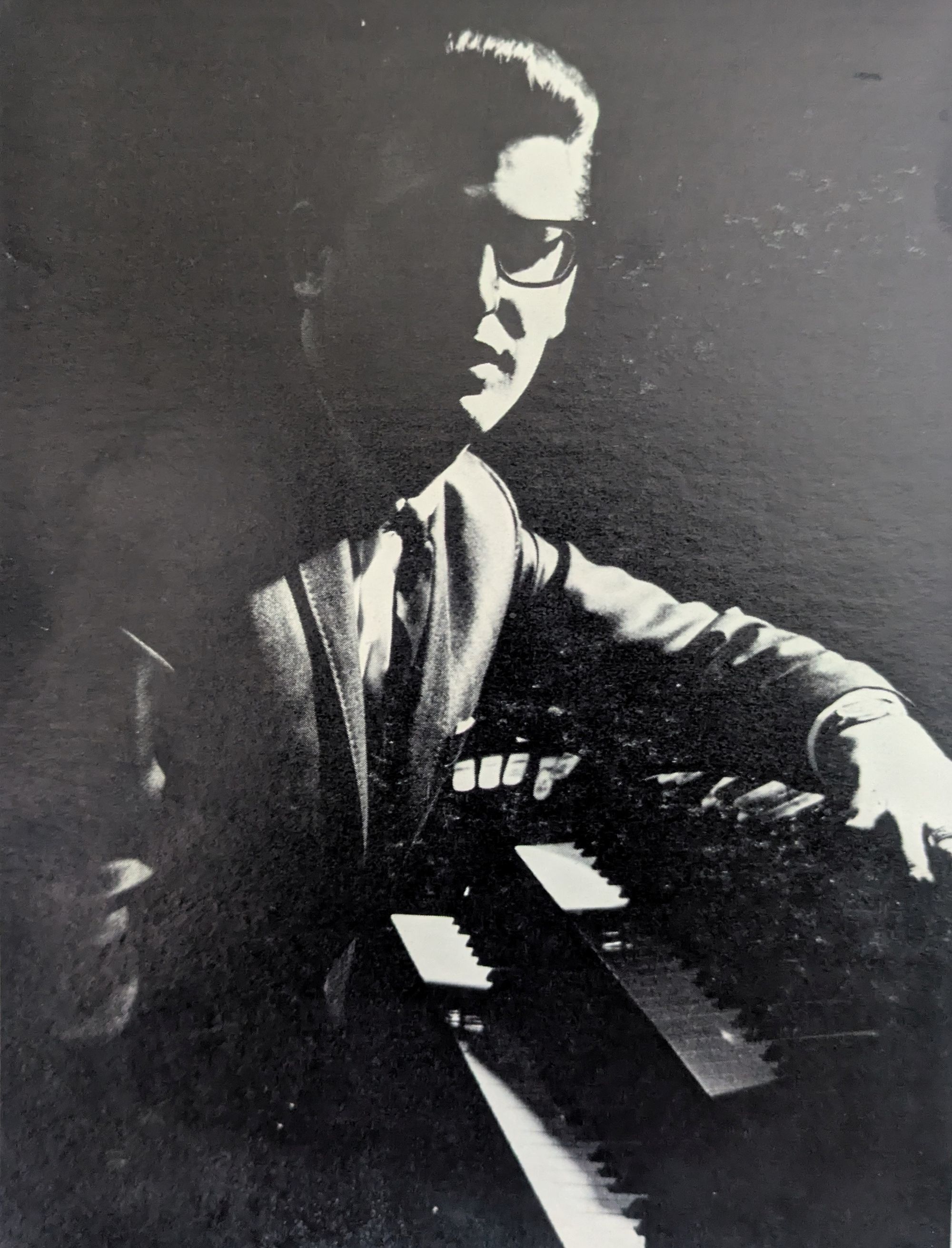
Skip O'Donnell, from the back cover
By the way, I have no idea who pressed this record, or when. There's no information on the cover, the runout groove etching is either nondescript or beyond my meager knowledge of these things, so I have no clue how he pressed it. He certainly spent good money doing so, the vinyl is nice quality and the cover is nicely photographed and typeset, which is more than you can say for a lot of fly-by-night private press joints. While the first Gulbransen transistor organ is well-documented (1957!), I struggled to find data on the three Rialto generations, as Gulbransen had lots of different names for their stuff. As far as I've been able to tell, Skip is playing on a Rialto II, which according to this service manual collection means that this record is from around 1976. This lines up with the 1977 date for the SOE single I link earlier in the page. My best guess is that this is a mid-70s release, but anyone who can identify a Gulbransen Rialto by eye from the cover can probably figure it out better than I could. In terms of music, the "newest" track on here not written by Skip is What Now, My Love written by Gilbert Bécaud in 1961, which doesn't really help. I couldn't find Mystic Woman in ASCAP/BMI's database either.
Liner Notes
Lots of people want to lead a band, but Skip O'Donnell had a slightly different yen [sic; old Chinese-derived word for "sharp desire"/"hunger"] - he wanted to be a band.
From the time he studied harmony and dance band arranging as a youngster in military school, it was the "total sound" in music that caught and held Skip's imagination. For other people, that might have meant a career as a composer-arranger; but, although he does both of those things, Skip recognized that his first love was performing.
The question was how to be a one-man band without becoming a kind of musical octopus with an instrument on each limb and one in the mouth. After classical piano lessons as a child and trumpet lessons as a teen, the young musician found his answer in the organ. It was a love affair from the beginning - one that required no lessons.
The musical magic began in 1958 when the 20-year-old performer was shopping around for a piano for a night club engagement. "The salesman was hepped on organs," Skip recalls, "and sold me on the idea." Instead of taking the night club "gig," Skip took a job at the music store playing the organ for fashion shows. [editor's note: I have no idea what is meant by a "fashion show" at the "music store".]
Since that time, Skip has entertained in the Lake Tahoe and Reno circuits, where he saw his name in lights in 1963. He has also appeared in Las Vegas and, since his marriage, has remained as a steady in the Orange County coastal cities.
His performances have ranged from big band to progressive jazz, depending on the audience at hand. In this album, however, he has struck a course which rejects the stylized echoes of the '30's. In every case, he has sought to imitate not other organists, but rather the full orchestral sound.
"The organ gives me a chance to improvise arranging," Skip explains. "When I play a bass line, it's not what most organists would play; it's what a bass player would play." The resulting richness and complexity is especially apparent in "Mystic Woman," an original piece created by Skip and recorded here. The key to this piece, as to many of Skip's arrangements, is the interplay between the melodic line and the chord progression.
Skip chose the Gulbransen Rialto Theatre Organ for this, his first album, because, he says, "it's the organ that copies what the original theatre organs set out to copy - the orchestra itself." The very real string sounds of the Gulbransen prove especially appropriate for this album; and if you think you detect a hint of Mantovani and his strings here, you won't be wrong. [editor's note: Mantovani was the conductor of one of the most successful easy listening orchestras of all time, though the comparison to Skip's work is somewhat baffling from a modern ear used to artifical synthesized sound]
With this album, Skip fulfills a childhood desire - he has become one man who plays a thousand strings.
Joy Fisher
Las Vegas Sun
Track List & Rip
Despite the fact that this is slowly becoming a blog about how a lot of mid-century organists happened to be synthesizer pioneers due to how the evolution of organ technology converges in a straight line to the monumental achievement that is the Yamaha DX7, I still think this is worth sharing, if only to hear Skip's original work for the first time in decades.
A1 - Shangri-La (Maxwell-Melnick)
A2 - Shadow of your Smile (Mandel-Webster)
A3 - Mystic Woman (Skip O'Donnell)
A4 - What Now, My Love (Bécoud-Delanoë-Sigmon)
B1 - Ebb Tide (Maxwell)
B2 - Summertime (Gershwin-Heyward)
B3 - My Clair de Lune (Debussy)
Get the rip HERE!